 dtourolle
981022ab1d
dtourolle
981022ab1d
`merge_remote_catalog` on the reference library (catalog_bench, a copy
merged with itself: the steady state of a sync pass) cost 228-231 ms best
of 5. Timing its phases put 91 ms in the keyword half, not in the faces the
issue named.

Both assignment unions refuse a word this device holds only as a tombstone,
with a correlated `NOT EXISTS (... deleted = 1) OR EXISTS (... deleted = 0)`
per incoming assignment. The `deleted = 1` half has no index to use --
`keyword_terms_name` is partial on `deleted = 0` -- so it scanned the whole
vocabulary for each of the 10,800 rows:

  SCAN rk
  CORRELATED SCALAR SUBQUERY 1
    SCAN t
  CORRELATED SCALAR SUBQUERY 2
    SEARCH t USING COVERING INDEX keyword_terms_name (name=?)

The refused words are one set for the whole statement, so it is asked once:
`rk.keyword NOT IN (tombstoned names EXCEPT live names)`, which is the same
condition -- refused exactly when deleted under some identity and live under
none -- and which SQLite builds as a list before the walk:

  SCAN rk
  LIST SUBQUERY 2
    MERGE (EXCEPT) ...

The file-id union alone went from 72 ms to 11 ms (sqlite3 on a copy), and
the keyword phase of the merge from 91 ms to 28-35 ms. Every table of the
catalog checksums the same after the bench as after the old build's run,
and the merge tests for tombstones and renames pass unchanged.
DarkRoom
A non-destructive RAW photo editor and library for Linux and Android, with a GPU develop pipeline, a catalog that syncs between devices, and no account, no telemetry and no cloud of its own.
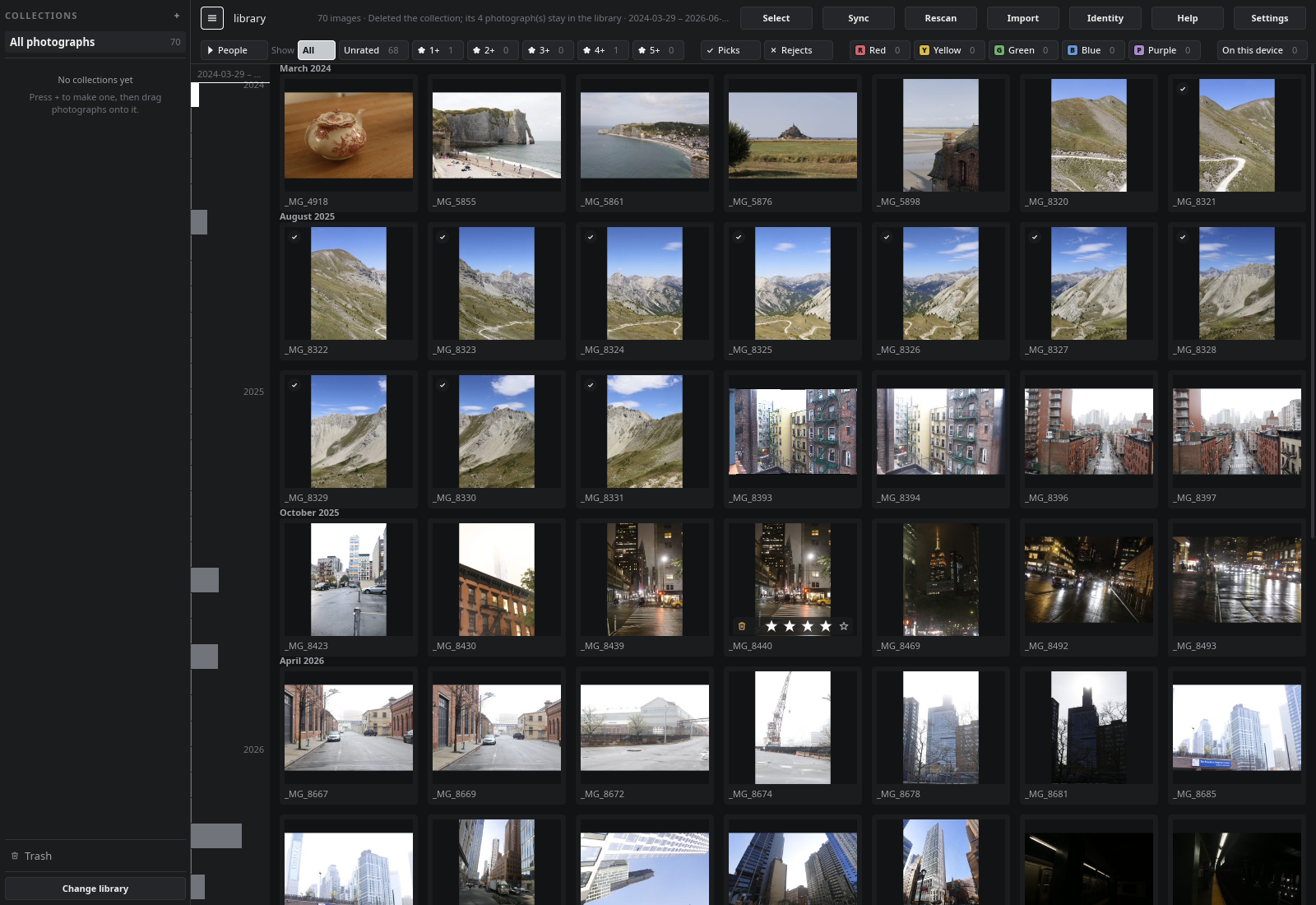
The manual shows every feature, pictured from the application itself. This page says what it is, how to get it, and what is still missing.
What it does
A library. Point it at a folder — on this machine, on a network mount, or one a Nextcloud client keeps in virtual-files mode, where a placeholder is treated as the photograph rather than as a one-byte file — or at a Nextcloud account directly. The grid is virtualised, ordered by capture time with a timeline beside it, and filtered by rating, flag, colour label, person and whether the file is here. Ratings, colour labels, keywords, collections and a trash that survives a crash mid-operation. Card ingest. Bursts fold. The same RAW catalogued twice — a dated folder and a backup beside it — is found, proved the same, and folded onto one copy with the spares in the trash. Face detection and identity, with the index syncing between devices.
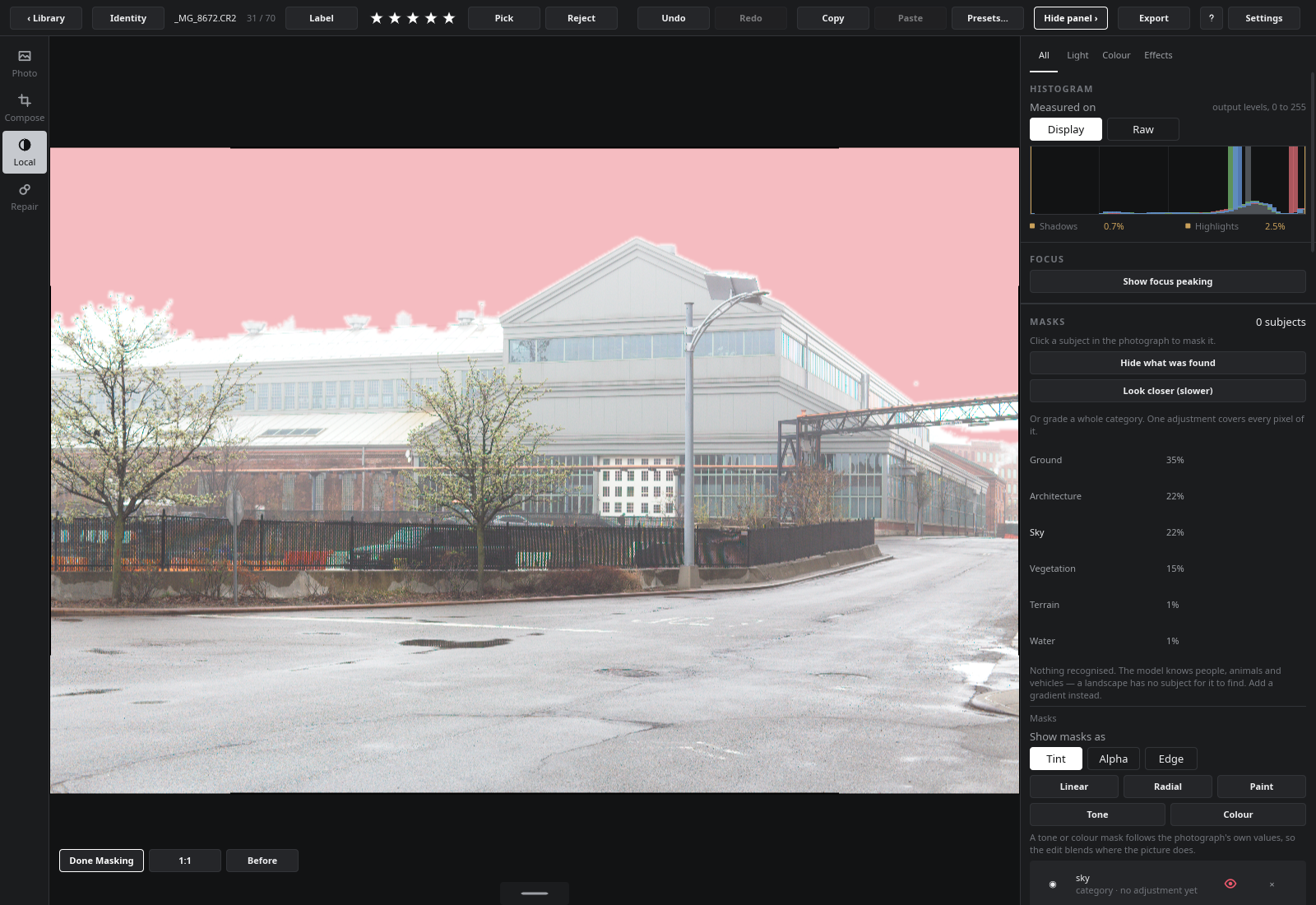
Developing. Eighteen declared operations fused into one compute dispatch, plus the neighbourhood work that cannot be: clarity, texture, capture sharpening, noise reduction, lens correction, spectral film simulation. Crop, straighten and correct converging verticals, spot repair, and local adjustments over masks the model draws — click a subject or a category, then paint, subtract a gradient or keep only where two selections agree, grow or shrink the edge. Focus peaking and a raw histogram for judging what is recoverable. Named presets; XMP sidecars other editors read.
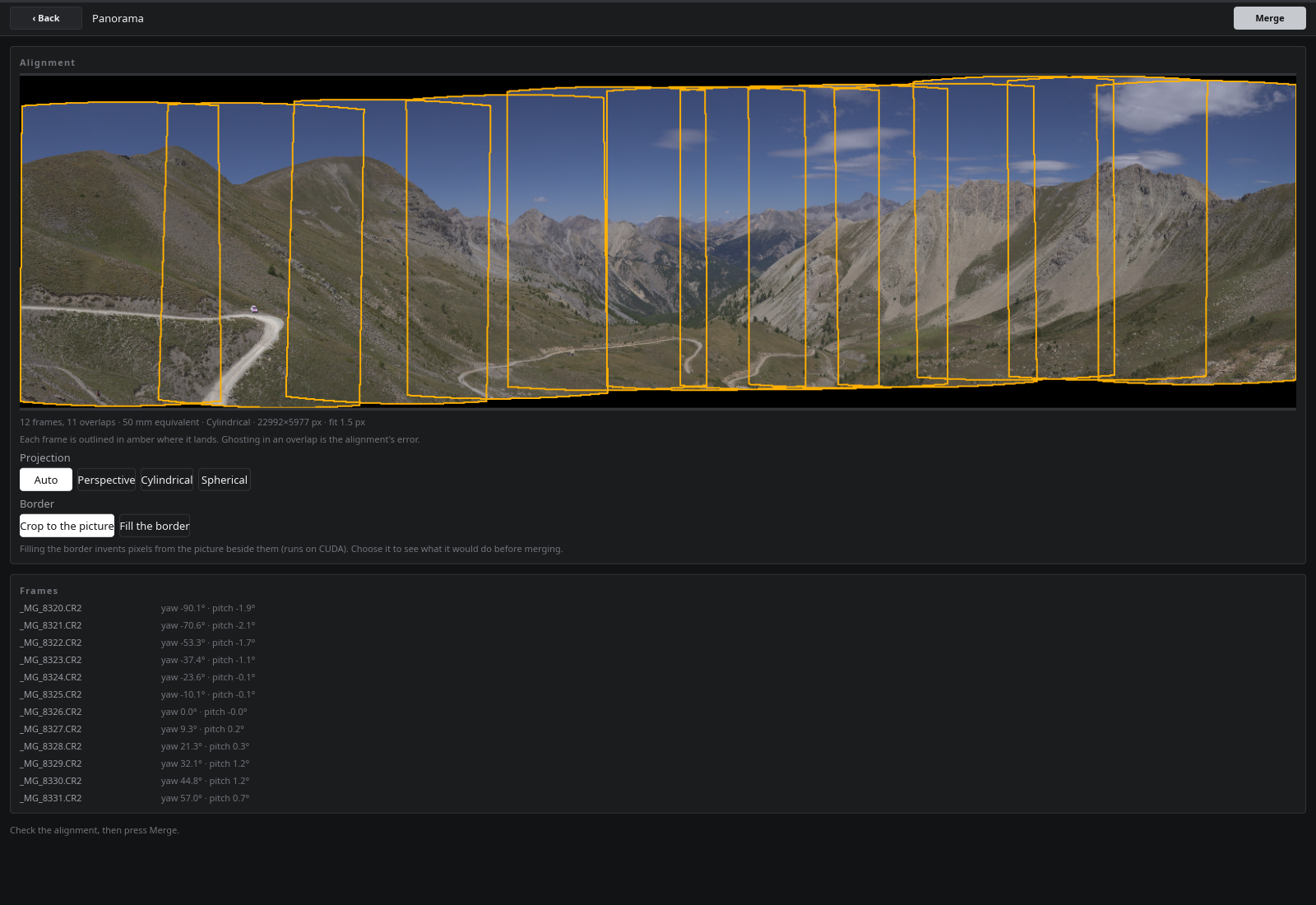
Panoramas. Select the frames, align, choose a projection, fill the ragged border rather than crop it, and the composite lands beside its sources as a DNG, with a sidecar recording what it was merged from.
From the keyboard, and with its manual. Rating, flagging and labelling
have keys in the grid and in develop, as do zoom, undo and stepping through a
shoot in develop, and none of them is keyboard-only. The help sheet (F1, or
? in develop) lists every key and gesture, generated from the code that
binds it, and links them to the sections of the manual that show them — the
manual ships with the application and opens offline.
Export. JPEG, PNG, AVIF, JPEG XL, 8- and 16-bit TIFF, with resize, output sharpening, a naming template and a colour space — to a folder here or back into the library.
On both platforms. The same core runs on a desktop and a 12-inch tablet; the interface is one layout, tuned for a wide viewport with touch targets throughout. On both, the develop view draws the compute pass's texture directly — no readback between the GPU and the screen.
Getting it
| Platform | How | State |
|---|---|---|
| Arch Linux | packaging/PKGBUILD — makepkg -si |
Built from every release |
| Android | The APK from each CI run, or ./docker/android/package.sh --install |
Runs on a tablet; F-Droid not yet submitted |
| Windows | DarkRoom-<version>-x86_64-setup.exe, cross-built by CI (windows.md) |
Verified under Wine only; unsigned |
| Flatpak | packaging/flatpak/ |
Manifest in tree; choosing a library does not yet work in the sandbox |
Or build it. Git LFS is required for the model weights, and the toolchain pins itself to 1.92.0:
git lfs install && git lfs pull
cargo run --release -p darkroom-desktop
Android, through the containerised toolchain (docker/android):
./docker/android/build.sh cargo ndk -t arm64-v8a build --release
CONTRIBUTING.md has the system packages, the four commands CI runs against what you send, and the shortest useful contribution — a develop operation is one YAML file, and it arrives with its controls, its place in the chain and its tests.
Where it stands
0.16.0, twenty-four tagged releases in. 191 numbered requirements in scope, 84% of them claimed by code and traced to it; the rest are written down rather than merely absent.
Not built: plugins (post-v1, D12), compare and survey culling, AI denoise, tiled rendering, HDR merge and focus stacking, importing a Lightroom or darktable catalog, translations beyond the launch screen, most of the Android platform integration beyond running, and the Flatpak's library chooser. The performance targets are half verified: the per-commit benchmark suite §8 requires exists for everything that does not need a frame — the catalog, the scan, the thumbnails — and not yet for the render path, so a regression there fails nothing. outstanding.md is the list, with the reasoning for each.
Documentation
docs/README.md is the index. The short version, for someone using it:
| manual | Every feature, pictured |
| gestures.md | How it is driven — generated from the code, so it cannot describe a gesture that does not exist |
For someone changing it:
| CONTRIBUTING.md | How to land a first change without reading the rest |
| requirements.md | What the software must do — the numbered register, and the decisions |
| architecture.md | How it is built — crates, the GPU pipeline, the data model, sync |
| technical-debt.md | Compromises taken deliberately, each with the condition that retires it |
| outstanding.md | What is not built, and whether that is a decision or a gap |
| code-health.md | What a contribution costs, per seam, measured |
| traceability.md | Generated: which requirement is claimed by which file |
Designs, one per subsystem: segmentation and mask editing · spot removal · panorama · faces · inference · storage and sync · catalog · display and extension · navigation · distribution · windows · benchmarks.
Licence
GPL-3.0-or-later. The photographs in the manual and the test fixtures are the author's and are there to show and test this project, nothing else. The model weights carry their own licences — models/LICENCE.md.