 dtourolle
a1d511fd4b
dtourolle
a1d511fd4b
library.rs was 7,729 lines wiring together everything "open a remote
library" touches: scanning, pulling other devices' judgements out of
sidecars found along the way, writing local edits back out to the
sidecar outbox, pushing/reloading XMP by hand, fetching and prefetching
thumbnails and originals, generating thumbnails locally, the metadata
and thumbnail background sweeps, on-disk paths for the catalog and
model files, and reading the grid's cells, spans and rating filter.
Same motivation as the develop.rs split (docs/dev/code-health.md CH-1):
a pure, no-behaviour-change move into one file per area, each under
about 1,500 lines.

Tracing actual call sites rather than trusting the file's physical
layout mattered here: `persist`, `load_folder_etags`, `pull_sidecars`,
`load_sidecar_etags`, `record_sidecar_read` and `apply_judgement` sit
textually beside the XMP push/reload functions but are called only
from `run_scan` (pulling a device's own past judgements out of the
sidecars a scan just walked), so they went to scan.rs and not xmp.rs.
`cells` came out at over 1,800 lines once its tests moved with it and
split further into cells.rs (windowed reads, trash, ordinals) and
spans.rs (collection scope, manual reordering, the capture-time
histogram) -- ten submodules rather than the nine first planned.

Previously-private items reached from a sibling module became
`pub(super)`, narrower than the whole-crate reachability one file gave
them. Tests moved with the code they test; the two test fixtures used
across more than one file (`scanned`, and develop.rs's
`session_with_a_left_half_subject` in the matching commit) joined the
shared `test_support` module alongside the existing `entry`/
`with_images`/`image_ids` helpers. `mod.rs` re-exports every module's
public items under `library::`, including the `pub(crate)`
`test_support` module `repairs.rs` reads its fixtures from, so no file
outside `library` needed a change.

The previous commit split develop.rs the same way; taken alone it left
dr-ui without library.rs, so that intermediate commit does not build on
its own. This one restores it.
DarkRoom
A non-destructive RAW photo editor and library for Linux and Android, with a GPU develop pipeline, a catalog that syncs between devices, and no account, no telemetry and no cloud of its own.

The manual shows every feature, pictured from the application itself. This page says what it is, how to get it, and what is still missing.
What it does
A library. Point it at a folder — on this machine, on a network mount, or one a Nextcloud client keeps in virtual-files mode, where a placeholder is treated as the photograph rather than as a one-byte file — or at a Nextcloud account directly. The grid is virtualised, ordered by capture time with a timeline beside it, and filtered by rating, flag, person and whether the file is here. Ratings, keywords, collections and a trash that survives a crash mid-operation. Card ingest. Bursts fold. Face detection and identity, with the index syncing between devices.
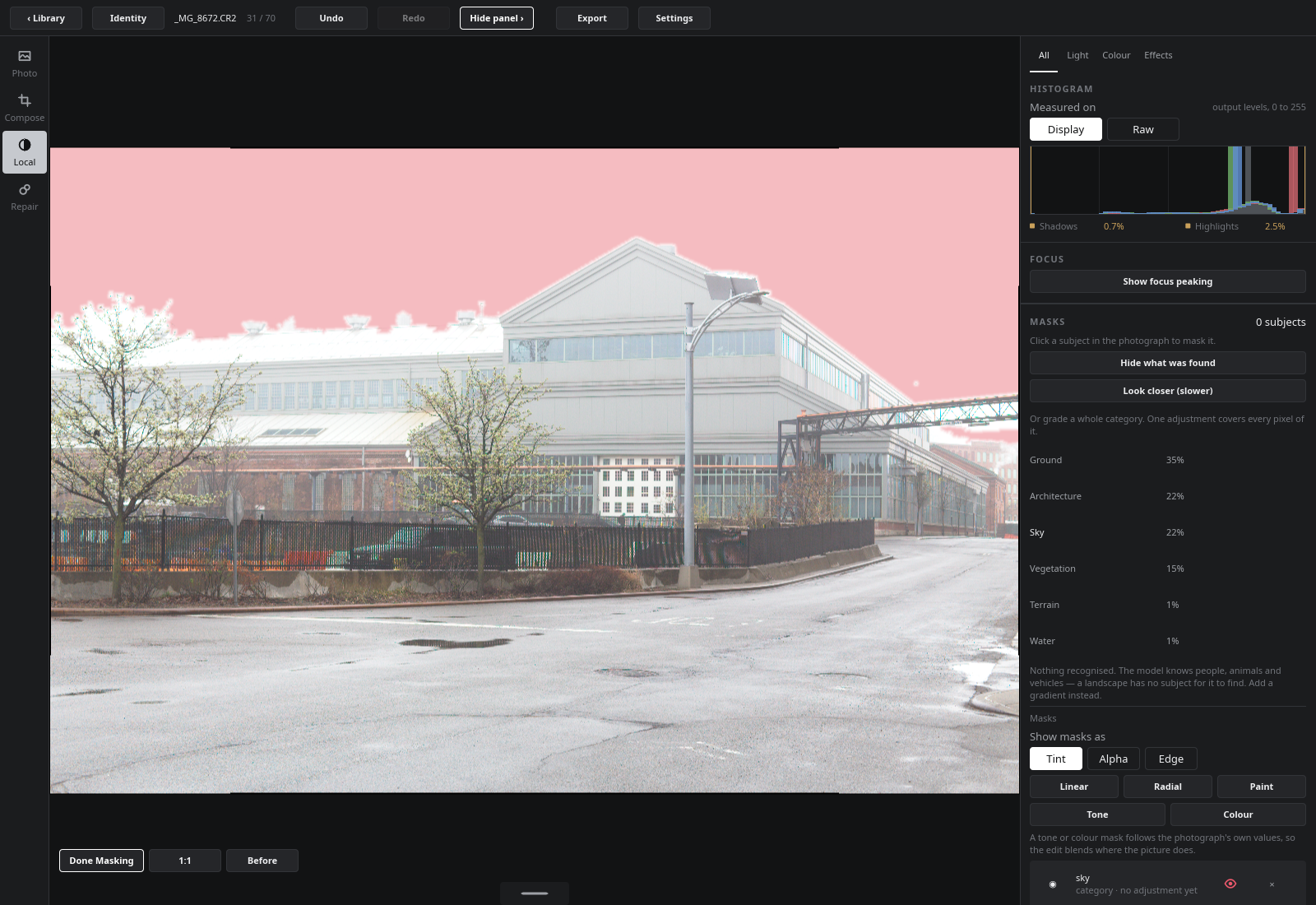
Developing. Eighteen declared operations fused into one compute dispatch, plus the neighbourhood work that cannot be: clarity, texture, capture sharpening, noise reduction, lens correction, spectral film simulation. Crop and straighten, spot repair, and local adjustments over masks the model draws — click a subject or a category, then paint, subtract a gradient, grow or shrink the edge. Focus peaking and a raw histogram for judging what is recoverable. Named presets; XMP sidecars other editors read.
Panoramas. Select the frames, align, choose a projection, fill the ragged border rather than crop it, and the composite lands beside its sources as a DNG, with a sidecar recording what it was merged from.

Export. JPEG, PNG, AVIF, JPEG XL, 8- and 16-bit TIFF, with resize, output sharpening, a naming template and a colour space — to a folder here or back into the library.
On both platforms. The same core runs on a desktop and a 12-inch tablet; the interface is one layout, tuned for a wide viewport with touch targets throughout. On desktop the develop view draws the compute pass's texture directly — no readback between the GPU and the screen.
Getting it
| Platform | How | State |
|---|---|---|
| Arch Linux | packaging/PKGBUILD — makepkg -si |
Built from every release |
| Android | The APK from each CI run, or ./docker/android/package.sh --install |
Runs on a tablet; F-Droid not yet submitted |
| Windows | DarkRoom-<version>-x86_64-setup.exe, cross-built by CI (windows.md) |
Verified under Wine only; unsigned |
| Flatpak | packaging/flatpak/ |
Manifest in tree; choosing a library does not yet work in the sandbox |
Or build it. Git LFS is required for the model weights, and the toolchain pins itself to 1.92.0:
git lfs install && git lfs pull
cargo run --release -p darkroom-desktop
Android, through the containerised toolchain (docker/android):
./docker/android/build.sh cargo ndk -t arm64-v8a build --release
CONTRIBUTING.md has the system packages, the four commands CI runs against what you send, and the shortest useful contribution — a develop operation is one YAML file, and it arrives with its controls, its place in the chain and its tests.
Where it stands
0.13.5, nineteen tagged releases in. 184 numbered requirements in scope, 84% of them claimed by code and traced to it; the rest are written down rather than merely absent.
Not built: plugins (post-v1, D12), compare and survey culling, AI denoise, tiled and progressive rendering, HDR merge and focus stacking, most of the Android platform integration beyond running, and the Flatpak's library chooser. The performance targets are half verified: the per-commit benchmark suite §8 requires exists for everything that does not need a frame — the catalog, the scan, the thumbnails — and not yet for the render path, so a regression there fails nothing. outstanding.md is the list, with the reasoning for each.
The one deliberate compromise worth knowing about before reading anything else: the Android develop view reads its frame back through the CPU, because zero-copy there needs wgpu's Vulkan swapchain and that tears a portrait window on a tablet whose panel is mounted landscape. It is debt, not a revision of the rule — technical-debt.md TD-1 has the measurements and the three things any one of which would remove it.
Documentation
docs/README.md is the index. The short version, for someone using it:
| manual | Every feature, pictured |
| gestures.md | How it is driven — generated from the code, so it cannot describe a gesture that does not exist |
For someone changing it:
| CONTRIBUTING.md | How to land a first change without reading the rest |
| requirements.md | What the software must do — the numbered register, and the decisions |
| architecture.md | How it is built — crates, the GPU pipeline, the data model, sync |
| technical-debt.md | Compromises taken deliberately, each with the condition that retires it |
| outstanding.md | What is not built, and whether that is a decision or a gap |
| code-health.md | What a contribution costs, per seam, measured |
| traceability.md | Generated: which requirement is claimed by which file |
Designs, one per subsystem: segmentation and mask editing · spot removal · panorama · faces · inference · storage and sync · catalog · display and extension · navigation · distribution · windows · benchmarks.
Licence
GPL-3.0-or-later. The photographs in the manual and the test fixtures are the author's and are there to show and test this project, nothing else. The model weights carry their own licences — models/LICENCE.md.